
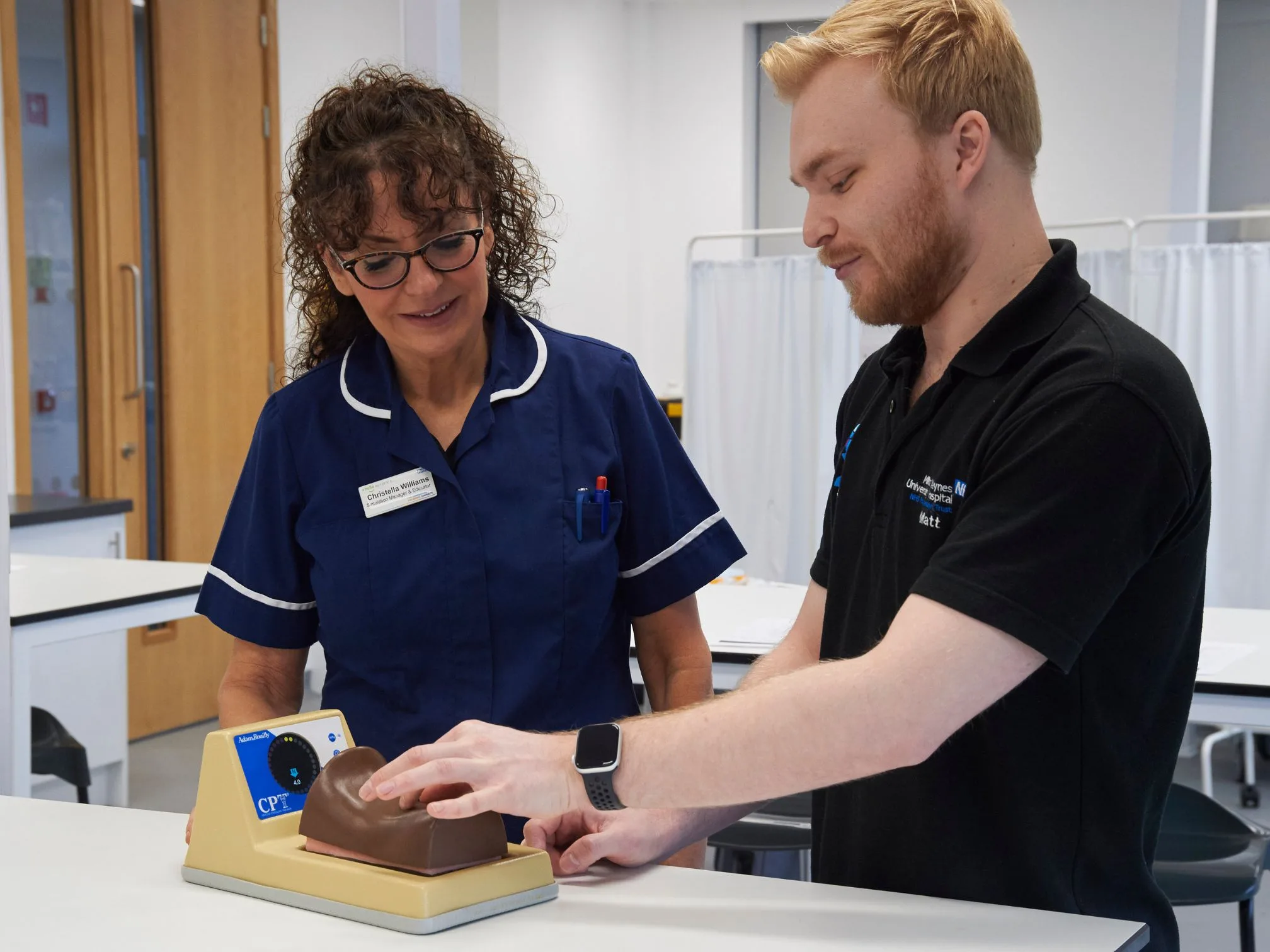
At Adam,Rouilly, we work closely with doctors, consultants and clinicians to develop medical educational models in response to specific training needs.
This includes our Digital Cricoid Pressure Trainer®. This simulator is used to train clinicians in applying the correct amount of pressure to the cricoid to prevent the inhalation of stomach contents in patients undergoing emergency anaesthesia.
We designed and manufactured the model in partnership with Dr Osman Abdelatti, Consultant Anaesthetist at Pennine Acute Hospitals Trust, who approached us after identifying the need for better training in this potentially life-saving technique.
He’d constructed his own prototype cricoid pressure trainer after being unable to find anything on the market that was realistic and effective enough to teach the skill – especially when it came to applying just the right amount of pressure.
The Cricoid Pressure Technique
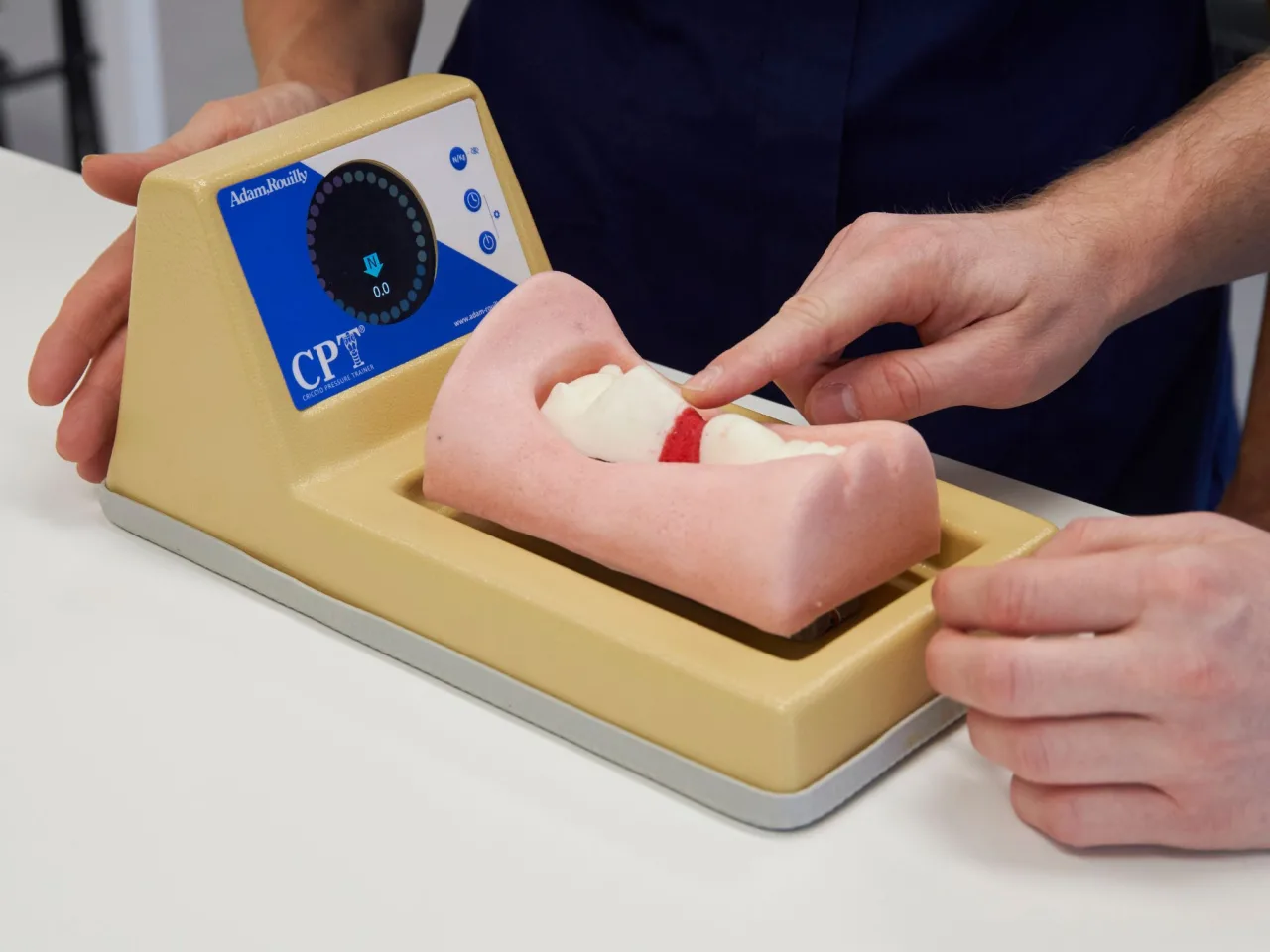
Often used during emergency and obstetric anaesthesia, pressure is applied to the cricoid cartilage at the front of the neck, blocking the oesophagus behind it.
This is to stop regurgitated stomach contents coming up the food pipe and passing into the lungs at the point when a patient loses consciousness from the anaesthetic.
Inhaling vomit can be very serious, with potential complications such as pneumonia, lung damage and even death, in extreme cases.
In planned operations, patients are required to fast for a certain amount of time to ensure their stomachs are empty before anaesthetic. Obviously in an emergency scenario, this may not be the case.
Cricoid pressure involves using three fingers – the index finger to apply pressure to the cricoid cartilage, and the middle finger and thumb to stabilise the larynx – until the patient’s airway has been secured by inserting a cuffed tracheal tube into the windpipe.
It’s also known as the Sellick Manoeuvre, after British anaesthetist Brian Sellick, who first described the technique in 1961.
Since then various studies have taken place to quantify the amount of force needed, which is now widely accepted as 10 Newtons before anaesthesia and 30 Newtons after anaesthesia.
Applying too much force could distort the larynx and make intubation difficult or impossible, and applying too little could result in aspiration.
Key features of the Digital Cricoid Pressure Trainer®
Ten years since we were first approached by Dr Abdelatti, our Digital Cricoid Pressure Trainer continues to be used in the training of operating theatre practitioners, obstetric and general anaesthetists and their assistants.
Easy to use and easy to set up, this clinical skills simulator has been carefully designed to offer a high-quality, realistic learning experience.
It includes:
- A translucent skin covering to aid visual anatomical understanding, and a flesh tone skin covering as proficiency is gained for scenario-based simulation
- True to life internal anatomy offering an authentic feel of the tracheal rings, cricoid cartilage, cricoid ligament and thyroid cartilage
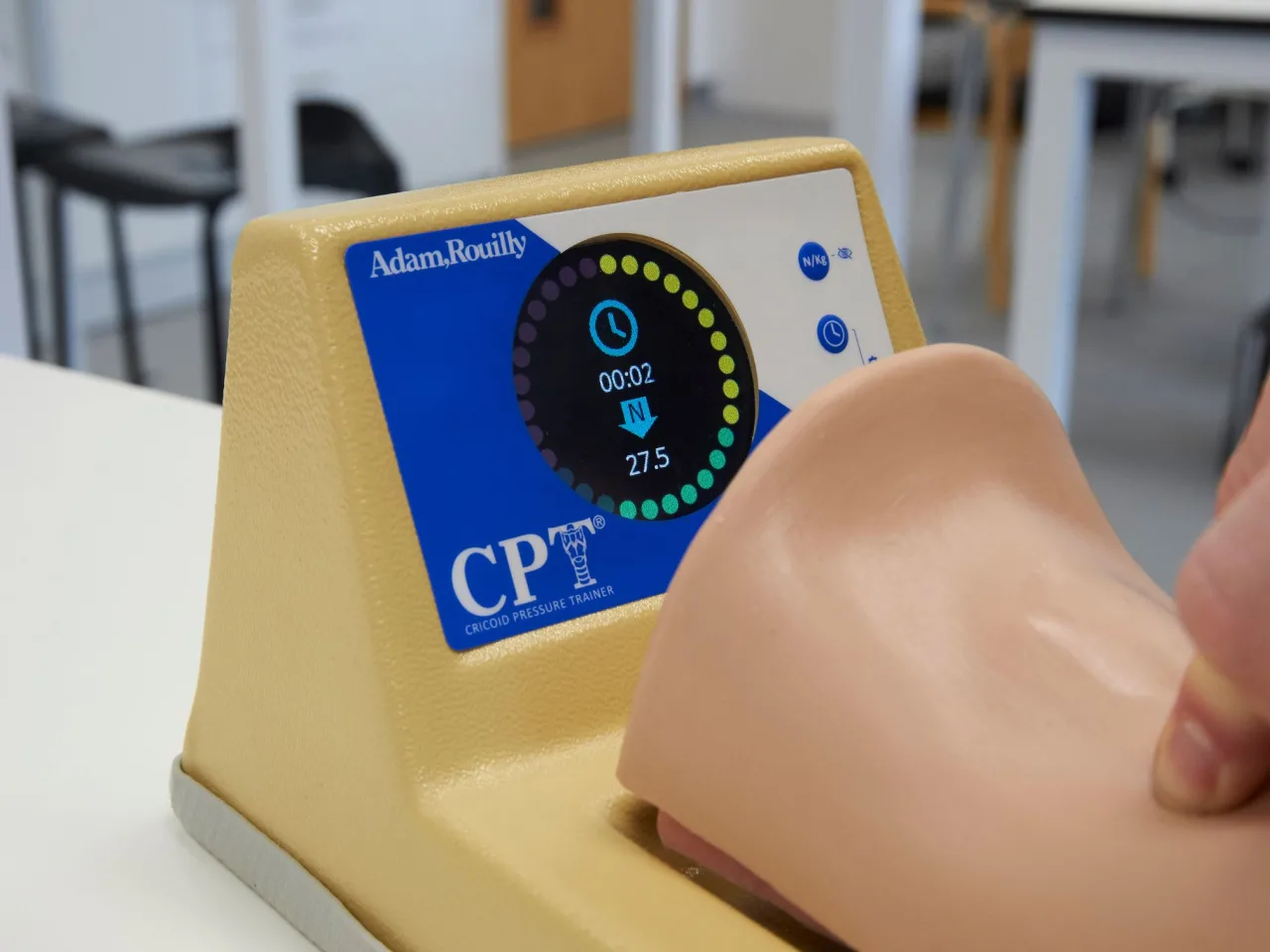
- A full colour digital display showing the degree of pressure being applied
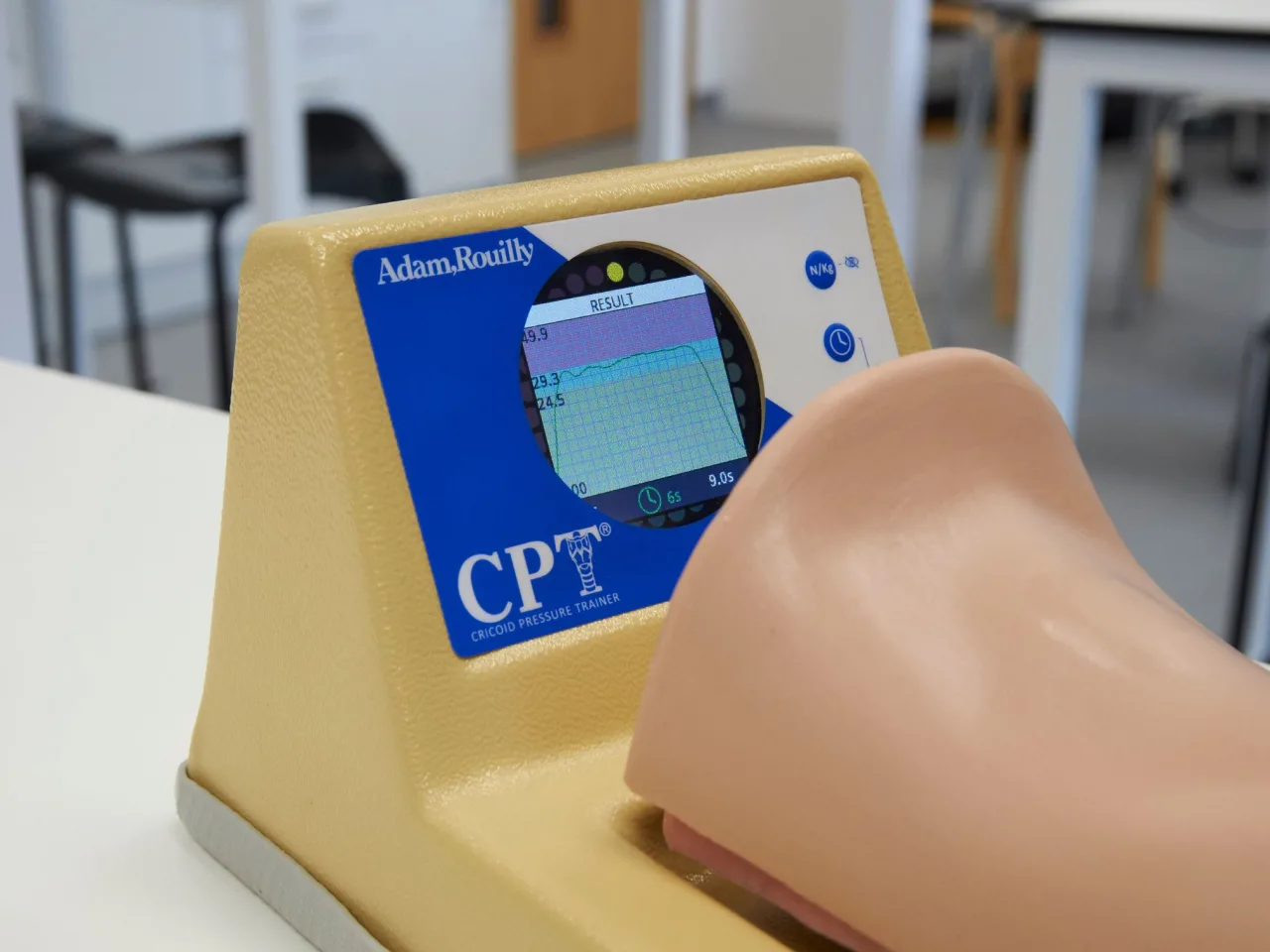
- The unit can be switched into the timer/feedback mode which records how long the correct pressure was held for, with an easy-to-understand graph provided for instant debriefing and discussion
- Exam mode hides the display, helping trainees learn the correct pressure through muscle memory
Discover the Digital Cricoid Pressure Trainer® in action
Learn more about how this simulator can enhance training and improve confidence in applying cricoid pressure. Visit the product page →
Ongoing clinical skills training and development
Cricoid pressure has been the subject of many studies and reports over the years, looking at the benefits of the technique and the role of simulation in effective teaching.
This article in the British Journal of Anaesthesia found simulation training using synthetic models or anatomical manikins improved patient safety and increased learner confidence.
Another study published in 2023, on training in the correct application of cricoid pressure, also found a significant improvement in knowledge and skills immediately after training.
However, it also noted that some of the skills were reduced after two months, as muscle memory can be quickly forgotten.
This highlights the importance of repeated practise on an ongoing basis, rather than just as part of a course or training module.
The use of the Sellick Manoeuvre is regularly debated and reviewed – as medical procedures and techniques often are – but its correct application continues to be a key consideration.
‘Ensuring cricoid pressure is done well, every time’ – Andy Buttery
As Andy Buttery (experienced ODP, instructor, simulationist and educator, previous Principal Lecturer & ASPiH executive member) explains: “The first simulator I ever had was home-made for training in application of cricoid pressure. No commercial models existed then, to my knowledge, yet the need for one was obvious to me.
“Cricoid pressure as a technique, it is fair to say, has been a topic of discussion since Sellick proposed it to reduce risk of aspiration (one of the common causes of death (all are unusual) related to anaesthesia) in the early 1960s.
“It is a classic example of a clinical skill that is difficult to teach in practice: observation – both for learning and assessment – isn’t particularly helpful; it’s employed in risky situations, and it demands teamwork. Yet one needs to get it just right first time and every time, and the skill has been shown to quickly fade without practice.
“The crux is this: how to ensure it is done well, every time.
“What is needed is a trainer upon which the trainee can progress to competence with aligned confidence, that can be available for just-in-time training to maintain skills, especially in areas where use is not routine.
“A cricoid pressure trainer should probably be available for training for anaesthetic teams in obstetric anaesthesia, emergency anaesthesia, and Rapid Sequence Induction – whenever Sellick’s Manoeuvre is called for – to enable deliberate practice and to ensure skill can be maintained.
“And, perhaps most important, I would add that de rigeur cricoid pressure begins on an aware patient and frequently in an emergency situation, so complete training that includes communication with the patient as part of the cricoid pressure skillset makes sense to me.
“I believe every practitioner should feel appropriately confident and competent as they reassure their perhaps frightened, traumatised patient as they press on their neck.”
Having a Clinical Skills Simulator which can be used both to teach cricoid pressure in the short term and to practise it over the long term can therefore be incredibly beneficial to those working in anaesthesia.
If you’d like to find out more about the Digital Cricoid Pressure Trainer, or our other Clinical Skills Simulators, please get in touch with our expert Sales Team who will be happy to help.
